| PORT PHILLIP CONSERVATION COUNCIL INC. | ||
 |
Tel
0395980554, 0429176725 A0020093K Victoria ABN 46 291 176 191 |
47 Bayview Crescent
BLACK ROCK VIC 3193
|
| PORT PHILLIP CONSERVATION COUNCIL INC. | ||
|
|
Tel
0395980554, 0429176725 A0020093K Victoria ABN 46 291 176 191 |
47 Bayview Crescent
BLACK ROCK VIC 3193
|
|
|
||||
| Port Phillip Conservation Council Incorporated, of which
I am the current President, is a federation of 15
conservation organizations around Port Phillip. It began
in 1970 with a Public Meeting in this Town Hall that
helped convince the then Bolte Liberal Government that a
proposed oil pipeline holding five million litres of hot
oil under pressure, buried under the seabed from Brighton
to Williamstown, and crossing under the main shipping
channel, was an unacceptable environmental risk to the
Bay’s waters and coast. Our organization has operated
continuously since. Our Web site - you can access it with any search engine - shows our current policies, and many successful major campaigns. The Save Western Port Coalition, in the 1970s, saved Victoria from Sir Henry Bolte’s proclaimed vision of Western Port becoming "the Ruhr of Victoria". We too have successfully motivated public opinion in favour of many good outcomes for Port Phillip. Note that the proposals for the oil pipeline, and the "Ruhr of Victoria", were overcome in the face of a comfortably ensconced Government with an enfeebled Opposition. That is not a dissimilar scenario from today.
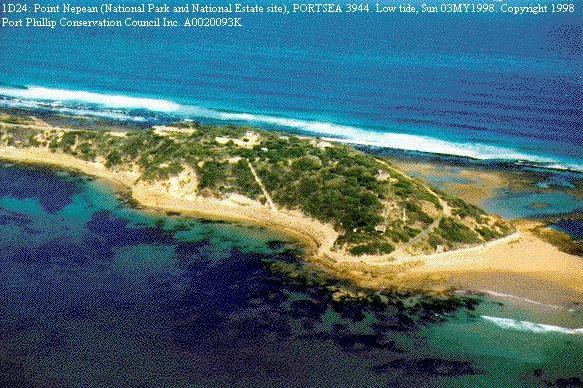
Participants in clearances of the entrance channel in the early 1980s, who are now retired, have told us that an internal controversy within the authority involved had led to a scaling down of clearance proposals then because of concerns about triggering a harmful and possibly uncontrollable increase in erosion of the narrow finger of land at Point Nepean that is all that prevents the Bay’s small 1 metre tidal range from eventually becoming the same as the large 3 metre range in Bass Strait. We were told that the compromise reached was:
The overall volume to be removed initially is proposed to be at least 30 million cubic metres, with further removal in subsequent maintenance dredging. There is a variety of proposals for placing that material. None of it is planned to go into Bass Strait as taking it there is said to be too expensive. It is planned largely to dump it in other parts of the Bay and on its coastline. Most of the material is clean sand from the south end of the Bay, with the rest being polluted clay and mud from the northern end. The interim reports appear very optimistic, without much basis for that optimism, about the virtues of the proposed outcomes of the spoil placements, and particularly about the stability of the material once it has been deposited. ARTIFICIAL
ISLANDS: Some of the material would
be added to the existing spoil grounds. These have
already shallowed the bay, and it would shallow them
further still. Other material is proposed to be built up
above the high water mark to produce extra land in the
form of proposed beach renourishment, refuge islands for
bird life, supposed "boat havens", and, in an especially
Orwellian turn of phrase, a one square kilometre
"environmental island" 4 kilometres off Rosebud. What is
the definition of this newspeak term, "environmental
island"? Is the term "environmental island" just a
propaganda term for a junk island formed to solve an
engineering problem? Will its predicted stability and
harmlessness prove to be correct, and what if they
don’t? There is no mention at all of the value of the square kilometre of seabed proposed to be covered with fill, or of the sea presently above it, which would be totally displaced, as being an environment of any consequence. How many people here tonight regard Port Phillip Bay as being further expendable? A leading Victorian coastal geomorphologist we have consulted has expressed great scepticism about the prospect of stability of such placements without substantial unsightly rock facings. Islands formed over geological time have come to an equilibrium with their surroundings long before we arrived. FILLING ELSEWHERE:
Maps of Tokyo
Bay and of Osaka
Bay show numerous large square-edged
islands formed from dumping of waste. One of those
many large "environmental islands" there is now the site
of Tokyo International Airport. San
Francisco
Bay has also been massively filled, partly to site
two international airports. Hong Kong’s Society for
the Protection of the Harbour has just lost its
legal challenge to a Government plan to fill 12 square
kilometres of Victoria Harbour, at 15 separate sites. At
Sydney Airport, Runway 34 Right and half of the longest
runway, the 4 kilometre long 34 Left, were formed by
filling in part of Botany Bay. Victoria nearly copied these bad examples when its Western Port (Steel Works) Act 1970, which has never been repealed, empowered the Victorian Government to give BHP until the year 2069 to fill defined areas of Western Port Bay with five times the volume of material now proposed for removal from the Port Phillip shipping channel, and to be given cheap freehold title to the land formed. If the sustained blowtorch of public opinion had not deterred BHP and the Government, that Bay filling could have happened. Give governments and developers a taste for bay filling, and you will find you mightn’t be able to stop them. It’s already been filled they say, so it’s no longer a natural feature they tell you, and a little more won’t hurt. OTHER ENVIRONMENTAL EFFECTS: The State and Federal Governments are fortunately subject to environmental effects legislation, which did not exist when some of the filling I have mentioned occurred. Investigations into the Channel Deepening proposal required by that legislation will be reported in May, and must be awaited before either government can give approval to the proposal. It is disturbing that early stages of official reports of these investigations declared that it was important that parliamentarians and municipal councillors should be lobbied to build up support for the proposal. Surely the proper business of such an investigation should be confined to an impartial examination of facts. It is fortunate that environmental legislation exists, but there is still a concern about what might be missing from environment effects statements without our realizing it, and also about how our adversarial political process deals with those statements. Fresh or independent viewpoints from our MPs are needed to examine proposals that could harm public areas like the Bay. Victoria might get some investigative MPs like that when the new proportional representation electoral system applies in 2006 - over two years away. That will be the first general election of the Legislative Council since it became a fully elected House 150 years earlier. For such a questioning MP to be elected in one or more of the new five-member Upper House regions, at least one-sixth of the voters in the region will need to support such candidates. Already information in the Key Features Report indicates that extra dredging of channels, both to gain the greater depth proposed, and to maintain it in the future, will produce considerable extra turbidity or murkiness of the sea water in Port Phillip. That is obviously adverse for marine life and for divers. The Key Features Report also forecasts the extra channel depth proposed causing an increase in the full tidal range in Port Phillip of 10 mm. That increase in range would result in the highest tide, the peak spring tide, which occurs for less than an hour once every fortnight, which is 0.3% of the time, rising 5 mm higher at high tide and falling 5 mm lower at low tide than now. That 5 mm is 1% higher than now. The rise above the present level at all other tide levels must be less than that 5 mm. At mid-tide and below, which accounts for over half of each day’s two tidal cycles, there will be falls due to the channel deepening, rather than rises. Nevertheless the maximum 5 mm rise, however brief,
would be a deliberate act superimposed on a larger
human-instigated, and highly threatening and unwelcome
increase, due to global warming, in the mean sea level,
which does not fluctuate throughout the year. The Report
estimates the increase in mean sea level due to global
warming, which is the same inside and outside the Bay,
as 30-60 mm by the year 2030. The combined effect on the
brief period that a peak spring tide occurs each
fortnight could, by 2030, thus reach 65 mm. Proponents of channel deepening suggest, particularly in relation to wave erosion issues, that the rise the project would cause is a small fraction of the greenhouse rise, and exceeds present limits very briefly, whereas the much larger greenhouse rise, which will occur whether the channel is deepened or not, applies 100% of the time. Opponents of channel deepening take the view that when a problem, such as rising greenhouse sea levels is looming, it is foolish to knowingly add to it in any way. GROWTH WITHOUT END: The pressure for vessels of ever deeper draught seems inexorable. The current proposal seeks to provide for foreseeable needs to 2030. That is co-incidentally the year by which another Victorian Government plan, the Melbourne 2030 Plan, seeks to make provision for a population increase of about 1,000,000 extra people. These two expansionist plans are obviously not unrelated. One striking similarity in the plans is their complete silence about what might happen after 2030 - just over 25 years hence - which is only six State elections away. Are the economics of shipping, which certainly do favour ever-increasing volumes for individual container ships, expected to lose their allure by 2030? There is no reason to expect the pressure to have larger ships, even if there are fewer ships by then, to disappear of its own accord. Victorians can expect renewed demands for yet deeper channels when 2030 arrives. The Victorian Government posted its Melbourne
2030 Plan booklet to all metropolitan
households before the 2002 election, which the
Government then won gaining an absolute majority of
seats in both Houses of State Parliament. The Opposition
did not oppose the expansionist nature of the 2030 Plan,
but concentrated instead on opposing its best aspect,
which is to enforce clear geographical boundaries to
expansion, although of course the boundaries can be
easily dispensed with at any time in the future. That
easy run for the Plan could be deceptive. Both
Government and Opposition have probably compared the
public’s passive reaction so far with the concerted
pressure by shipping and manufacturing groups and trade
unions, and the Government and the Opposition each
appear to have settled for the line of least resistance.
That will only change if public opinion starts to react against the cargo cult and expansionist approach inherent in the Melbourne 2030 Plan. The expansionist approach will lose credibility if public opinion comes to see Melbourne as having grown too large, and that it is quality not quantity that will be important to our future. The Labor Premier of New South Wales, Bob Carr, has already said, firmly and lucidly, that the population of Sydney is large enough. Let’s hope Melbourne and Victoria wake up soon. As the environmental effects of deeper channels are enduring, and cumulative, Victorians will need to end this practice of ever-increasing modification of Port Phillip, and ever-increasing population pressure around it, at some time. Like many addictive and harmful habits, it is better to terminate the habit earlier when it is manageable rather than later when it has got a greater hold and has done more damage. The problem with a compounding habit we have had for the last 170 years is that it has grown on us and we have not thought enough about where it is leading us. The recent move, on economic grounds, to much greater specialization among nations and far less self-reliance, leading to much greater movement of goods between countries, appears not to have adequately considered the emerging environmental costs and disadvantages of the enormous extra transport activities involved. A more realistic assessment of the total real costs might lead to some scaling back of some forecast utopias. RAIL: The present proposal should have been presented in more fundamental terms. The real, underlying purpose is to provide means of handling the passage of more imports and exports to Victoria, and not just Melbourne, and not necessarily assuming that so much of the goods will move by sea. With such wider, and more fundamental terms of reference, wiser regard can be had to the interests of the rest of Victoria, which is not overcrowded, and also to the interests of Melbourne, which is overcrowded. A shipping-only approach gives a rigid inflexible, highly-centralized transport system, concentrating on expensive and highly desirable land on the edge of the Bay, whereas more emphasis on transport of Victoria’s imports and exports by rail would give a much more adaptable, decentralized ingredient to our transport system. We are not proposing any reduction in the existing port size, but rather seeking rail transport as a better way of handling the extra volume expected in the future. We have presented that view to two Ports Ministers, to Victorian Channel Deepening information sessions, and in our written comments on the EES process. That has not resulted in the Government thoroughly costing a greater use of rail for moving goods into, out of, and particularly importantly for non-metropolitan Victoria, across Victoria to reach naturally deep water Australian ports. Note that ships in and out of Melbourne go nowhere else in Victoria, whereas rail transport would. More rail transport across Victoria would be be more expensive than shipping, but investment there must create opportunities for non-metropolitan Victoria, and take pressure off Melbourne. Victoria, the second smallest State, is only 3% of
Australia’s area, and much of it is mountainous. The
centre of gravity of Australia’s population is moving
northwards at one kilometre per year. Victoria should
concentrate more on maintaining a balance between
industry for Melbourne and the recreational and natural
values of our surroundings, such as Port Phillip, and
also industry and activity in the rest of Victoria.
Further channel deepening points to an increasingly
bloated Melbourne, with the rest of Victoria frustrated
by Government neglect. ****************
|